
Read Labette's Current Owner Card
The Labette County parcel portal holds the current roll for every parcel in the county. Public access covers general property information. Registered users also see sales data. County guidance draws that line. The public card has a quirk: the Public button has returned a server error for some visitors, so treat the table as a list of owner fields to request and verify. The official portal landing page shows the sign-in options for both public and registered access.
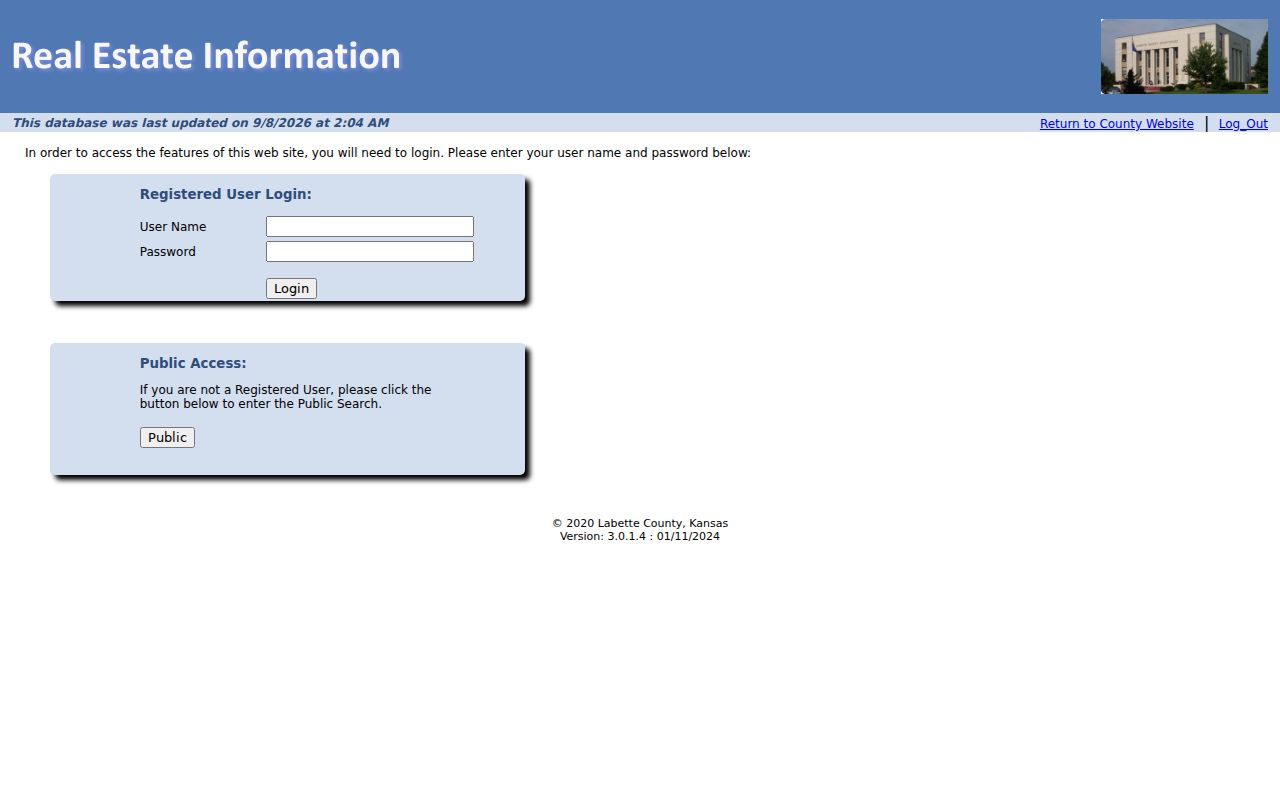
That screen marks the access split. Visitors with public access still see owner information, but any name deserves a comparison with the newest matching deed.
| Owner name | The roll's present owner lead; preserve initials, punctuation, and entity suffixes. |
|---|---|
| Mailing address | The notice destination, which may differ from the property. |
| Situs address | The parcel's street location, not the owner's residence. |
| Parcel and legal text | The keys used to match the map, tax account, and deed. |
| Value or sale data | Public access excludes sales; registered access adds them. |
| Record date | Ask when ownership data was refreshed; do not equate it with a deed date. |
Owner and occupant can differ. An owner may take notices at a post-office box, a business office, a trustee address, or a home in another city. Use it only for a lawful property inquiry.
How Current Is Labette Ownership
Labette County reappraises every parcel annually, valuing each property as it exists on January 1. That cycle is about value. Owner names can lag behind. No verified update schedule exists. A newly recorded deed can predate the roll's owner entry after a recent closing. Compare the deed date to the roll. Ask the Appraiser at 620-795-2548 when the owner field was last refreshed, and ask the Register of Deeds for the most recent instrument matching the parcel's complete legal description.
Recent-sale check. The roll can trail a recorded transfer. The newest matching deed is the more current public evidence of the conveyance.
Mailing and Situs Serve Different Roles
A situs address locates the land itself. A mailing address routes tax and valuation notices. Rural routes, post-office boxes, trust offices, and out-of-area owners push the two fields apart often enough that each must be read for its own purpose. When an address search misses, the legal description is the durable tie-breaker. City parcels lean on lot, block, and addition language. Rural tracts use section, township, and range, and staff at the Appraiser's and Register of Deeds offices can work from that description when the portal fails.
- Assessment roll
- The county's property list for ownership, classification, and valuation work.
- Situs
- The physical property location.
- Mailing address
- The destination for notices, not proof of residence.
- Recording lag
- The unmeasured interval between a transfer and a later roll update.
Confirm the Current Labette Owner
Recorded deeds sit at the courthouse. The Register of Deeds publishes no online grantor-grantee index. Staff does not perform searches either, so arrive with the owner's exact spelling, the parcel number, the legal description, and a narrow date range.
- Capture the roll's exact owner name, parcel key, situs, mailing address, and legal text.
- Locate the newest recorded conveyance for the same legal description.
- Compare its grantee and date with the roll. Investigate any newer deed or mismatch.
- For a registered entity, cross-check the exact name through the Kansas Secretary of State.
- Owner of record
- The party the government roll currently associates with the parcel.
- Grantee
- The party receiving an interest in the deed.
- Registered agent
- A designated contact for a registered business entity.
Current Labette Entity Ownership
A Labette County owner of record may be an LLC, corporation, limited partnership, trust, estate, or life estate. Copy the spelling exactly. Punctuation and suffixes matter in a deed match. Never swap the entity for an individual name unless another official record supports that link. The Kansas Business Entity Search takes a business name, a Kansas SOS Business ID, or a resident agent, and results can show status, entity type, mailing address, formation details, and public filings. Sole proprietorships and trade names fall outside that system. Trusts work differently. A trust or estate may call for probate or deed records instead.
Public Labette Access Excludes Sales
Labette County's public parcel option leaves out sales. Registered access includes them. That split is an access rule, not a confidentiality label on public owner data. Call the Appraiser for registration rules and portal help.
A sale field and an owner field answer different questions anyway. Sale data may show price or a prior event. The deed names the parties and describes the land, so never infer a transfer from price data alone.
Note: The portal's exact public fields, wildcard behavior, result limits, and owner-name update timing remain unpublished by the county.
When the Labette Card Fails
A broken public button is not a dead end. Call or visit the Appraiser at 501 Merchant in Oswego with a situs address and legal description. The county GIS page can help locate the tract. The recorder then provides inspection of the newest deed.
A narrow KORA request can also seek an existing public parcel record. Kansas agencies need not answer questions or build a new report. A custodian may charge copying or staff costs. Ask for the record by parcel number and date, and let the recorded instrument speak for itself rather than asking staff to decide ownership.
Probate May Delay Owner Display
A death does not rewrite the land record. Probate moves slowly. A representative deed, court order, affidavit, or trust provision may sit inside a pending transfer. The owner field may lag meanwhile. The Kansas Courts Smart Search offers a public lead on case activity. Older material may need a courthouse terminal or records request. Court results explain the proceedings. The newest matching recorded instrument remains the land-record confirmation of ownership.
Document the Labette Verification
Write down how you reached your conclusion. Note the date you pulled the tax roll. Record the exact owner spelling, the parcel number, and the legal description, plus the situs and mailing address. Save the deed details too. The instrument or book-and-page reference, recording date, grantor, grantee, and matching legal text all belong in the file. This trail keeps a stale screenshot from passing as current Labette County property records.
Names can disagree. When the roll and the deed records show different owners, never merge them. Keep both records with their dates. Ask the Appraiser whether a transfer update is pending. Ask the Register of Deeds whether any newer instrument affects the same tract.
Not every filing changes ownership. A mortgage, release, or assignment can relate to the land while the owner of record stays the same. So identify the document type first. For a purchase or an estate decision, public records are the starting evidence. Start there, but do not stop. A title professional can search recorded interests and exceptions beyond the simple owner field. A survey professional handles line and encroachment questions.
A name alone is not enough. A same-name account elsewhere in Labette County may sit on different land entirely, so match at the parcel level before you trust an owner result. Check the name against the parcel classification and the legal text on the deed. Recheck both sources near the date of any decision.
Use Labette Owner Data Lawfully
Kansas Safe at Home offers real protection. It can replace a qualifying victim's public address with a substitute legal address and a mail-forwarding route. State law also requires Social Security number redaction in many public records, with stated exceptions. An assessor name is a discovery record. It is not a title opinion. It cannot prove clear title, name an occupant, or settle a boundary, so buyers, heirs, and easement parties should examine the deed, plat, court order, and other instruments. Honor both protections in any Labette County owner search.
Lawful use. A public mailing address may support a legitimate property inquiry. Never use current-owner information to stalk, harass, intimidate, or harm anyone.