
Read Labette County Property Tax Records
Two county systems produce Labette County property tax records. The Appraiser sets the January 1 appraised value and derives the taxable assessed value. The Treasurer then issues statements, collects payments, and tracks delinquency. Read both documents before drawing a conclusion. A valuation notice estimates value. A tax statement reports the amount billed.
| Field | What It Shows | Where |
|---|---|---|
| Appraised value | Estimated fair-market value, except agricultural land uses the state use-value method | Appraiser |
| Assessed value | Class-based share of appraised value used in the tax calculation | Appraiser |
| Classification | Residential, agricultural, vacant-lot, commercial, or another Kansas class | Appraiser |
| Statement and installments | Tax billed, due dates, and payment route | Treasurer |
| Delinquency | Balance that must be confirmed by phone and possible foreclosure track | Treasurer |
None of these figures predict a sale price. Kansas classification rates convert appraised value into assessed value. Taxing districts apply their levies on top. A recorded deed captures a different kind of fact entirely. Use each county record for the purpose it was made.
Labette County's January 1 Value Snapshot
The Labette County Appraiser reappraises property every year under Kansas law. It values real estate as it stands on January 1. Real estate, personal property, commercial property, and oil-and-gas property all pass through the annual review. Kansas also requires the office to physically review 17 percent of real estate each year. The office notes new construction and demolitions while doing so.
That cycle explains a common lag. A recent remodel or sale may not yet appear in the current Labette County property tax record. The tax roll is a dated government snapshot. It is not a live market feed.
Note: Compare documents from the same tax year before treating a difference as an error.
How Kansas Classes Shape Labette County Property Tax
Kansas applies no single assessment percentage to every tract. The official Kansas Department of Revenue guide lays out the class rules that work alongside Labette County values.
| Property class | Share of appraised value assessed | Reading tip |
|---|---|---|
| Residential | 11.5% | Do not compare the assessed figure directly with a sale price |
| Agricultural land | 30% | Appraisal follows state-governed use value |
| Vacant lots | 12% | Confirm the parcel's class on the notice |
| Commercial real property | 25% | Keep real-property and business-property records distinct |
Classification matters whenever you compare two Labette County property tax records. Two parcels with equal appraised values can carry different assessed values simply because their classes differ.
The Green Notice Is Not a Labette County Tax Bill
The county valuation page describes the green-envelope notice as an official estimate of value only. It is not the Treasurer's bill. The notice opens the review period and reports the Appraiser's work; the statement that follows later reports the actual tax obligation.
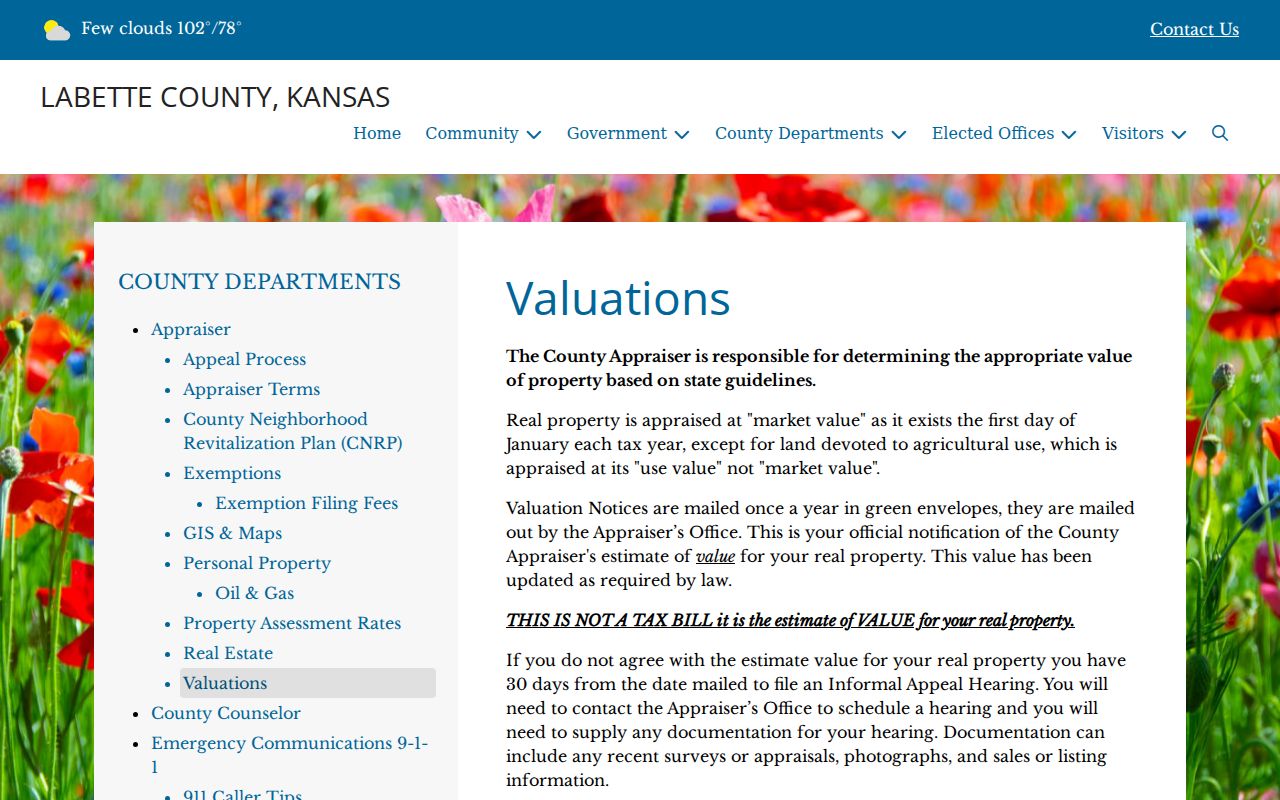
The captured county page documents the annual notice and informal-review route.
Keep the documents separate. A valuation notice supports a value review, while a Treasurer statement governs payment dates and balances.
The distinction prevents a common mistake. Owners treat the assessed figure, the appraised figure, and the final tax amount as interchangeable. Each one answers a different question.
Trace a Labette County Tax Bill
The county publishes a parcel portal and payment guidance. But it offers no public fielded tax-bill lookup. Expect a mix of online searching and direct Treasurer confirmation. Start with the property identity. Then ask for the exact tax year. The official parcel landing page is the entry point for the search.
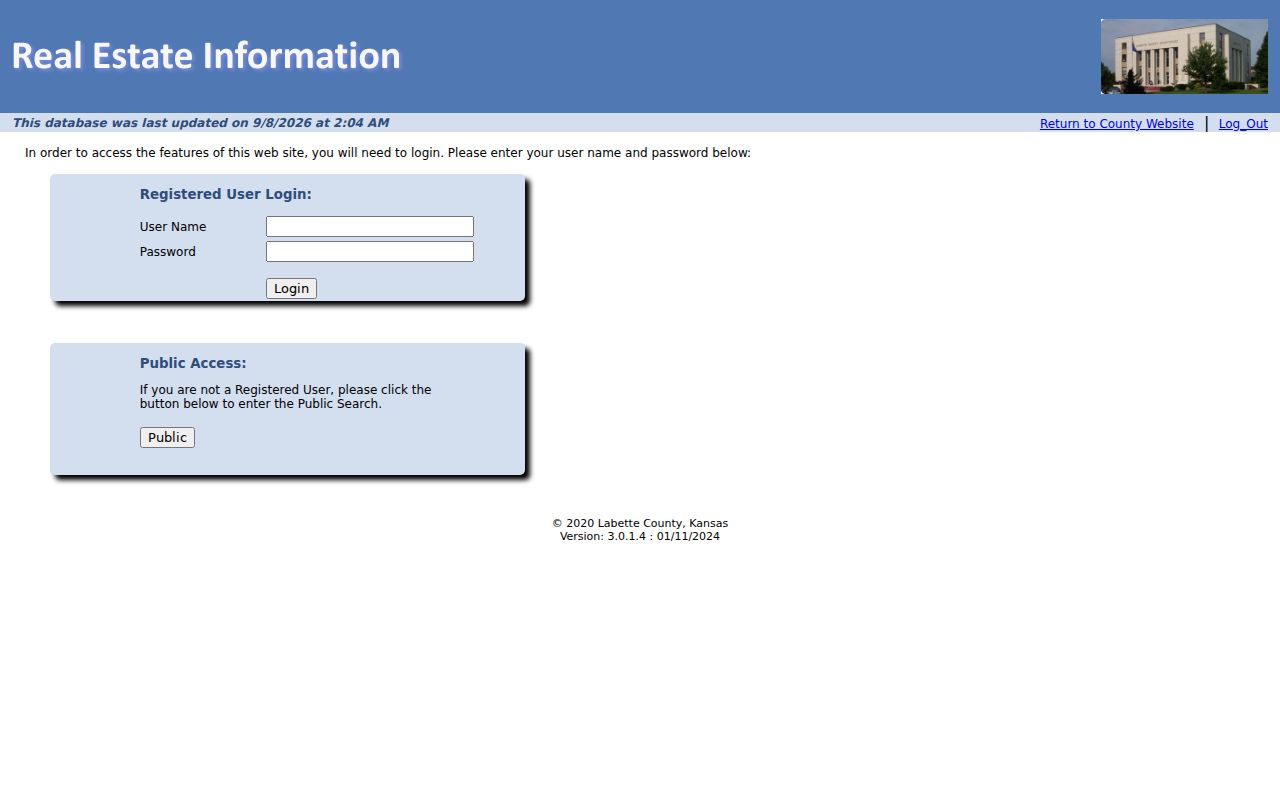
It confirms public and registered entry choices, not a public tax-bill result.
- Open the Parcel Real Estate Information Search and identify the parcel.
- Keep the street address, owner spelling, parcel reference, and requested tax year together.
- Review the Treasurer's tax information for the statement calendar.
- Call 620-795-2918, option 2, for a delinquent balance or a record the web route does not expose.
- Assessed value
- The class-based value to which taxing levies apply.
- Levy
- The rate imposed by the relevant taxing authorities.
- Exemption
- A statutory treatment that can change taxable effect; verify eligibility with the office.
- Tax lien
- The public claim associated with unpaid property tax.
Two Labette County Property Tax Due Dates
Statements go out after November 1. The first half comes due December 20. Pay that half on time. The second half is due May 10. However, the Treasurer mails no second-half statement. The online payment page opens payment windows from November 15 through December 20. It opens again from February 1 through May 10.
A payment page is not a complete delinquency ledger. A balance can run late, so call the Treasurer for the true amount. Do not infer it from an ordinary payment screen.
Note: Set a calendar reminder, because no second statement arrives for the May installment.
Delinquent Labette County Tax Records and Sale Notices
The Treasurer publishes delinquent real estate for three consecutive weeks each August. Taxes left unpaid for three years can move toward foreclosure and public auction. The county cautions that the process can be slow. It can run a year or longer once that track begins.
A tax-sale notice is a sale document, nothing more. It offers no warranty of condition or title. Bidder eligibility, redemption conflicts, occupants, and other terms appear only in the county announcement. Anyone researching a distressed parcel should confirm the current balance and case status with the Treasurer and the court. The county's own records beat an older newspaper list.
Use Every Labette County Property Tax Access Channel
The online parcel page is only a discovery point, not the whole record. Its Public Access button returns a server error. The county publishes no fielded public tax-bill database either. A dead link should send you to the county offices. It should not send you to a claim that the Labette County property records are gone.
Phone calls split the work neatly. Call the Appraiser at 620-795-2548 for the parcel record, classification, valuation notice, or annual appraisal question. Call the Treasurer at 620-795-2918 for the statement, payment status, and delinquent balance. Both offices sit at 501 Merchant in Oswego. So one visit can join the value and the bill while the records stay distinct. A written request should state the property address, parcel number if known, owner spelling, and tax year. It should also name the exact existing document wanted.
The Kansas Open Records Act covers existing records. It does not require an office to create a new analysis. Ask the custodian which office holds the item. Ask what copying cost applies. Court files run through separate channels. A foreclosure or contested-tax case lives in the Kansas Courts Public Portal. Or it lives at a courthouse terminal. Older material missing from the web may need the relevant office file. It may also need a published newspaper notice.
Use the whole chain. Portal, phone, counter, written request, public notice, and court record each answer a different failure point. Together they make Labette County property tax research far more reliable.
Match a Labette County Tax Record to the Right Year
Three dates need care. Keep the January 1 valuation date, the valuation notice mailing date, and the Treasurer's installment dates separate. A late-year sale is the classic trap. A sale or new structure may belong to a newer deed or a future appraisal cycle even though the current statement still reflects the existing roll.
Build a compact comparison sheet. List parcel number, tax year, appraised value, assessed value, classification, notice date, billed amount, and payment status. Enter only fields found in the source document. That discipline often shows an apparent conflict is really a source-date difference.
Levy questions live elsewhere. Special-district, city, and school levy information belongs with the Treasurer and county administrative records. The County Clerk keeps budgets for schools, fire districts, cemetery districts, watersheds, cities, and other special districts, and those budgets explain the public bodies behind a levy while the parcel's statement supplies the property-specific charge.
Prepare a Labette County Valuation Review File
Start with one folder. Put the notice, parcel record, photographs, and dated evidence there before speaking with the Appraiser, and name the fact under challenge, whether classification, physical description, condition, or the value conclusion. The county itself names recent surveys, appraisals, photographs, comparable sales, and listing information as useful support.
Keep a copy of anything delivered. Note the date, method, and recipient. Someone acting for the owner needs the county's Declaration of Representative for the relevant year. These steps do not guarantee a change. They make the issue clear and preserve the procedural trail.
Challenge a Labette County Property Tax Value
An informal hearing is the first opening. The clock runs 30 days from the valuation notice's mailing. Strong evidence, per county guidance, includes a recent survey, an appraisal, photographs, comparable sales or listings, and other material tied to the property. A representative must file the county's Declaration of Representative for that tax year.
Act from the mailing date. The informal appeal request is due within 30 days after the notice is mailed; use the county appeal instructions and confirm receipt.
The manifest also captured the official appeal page.
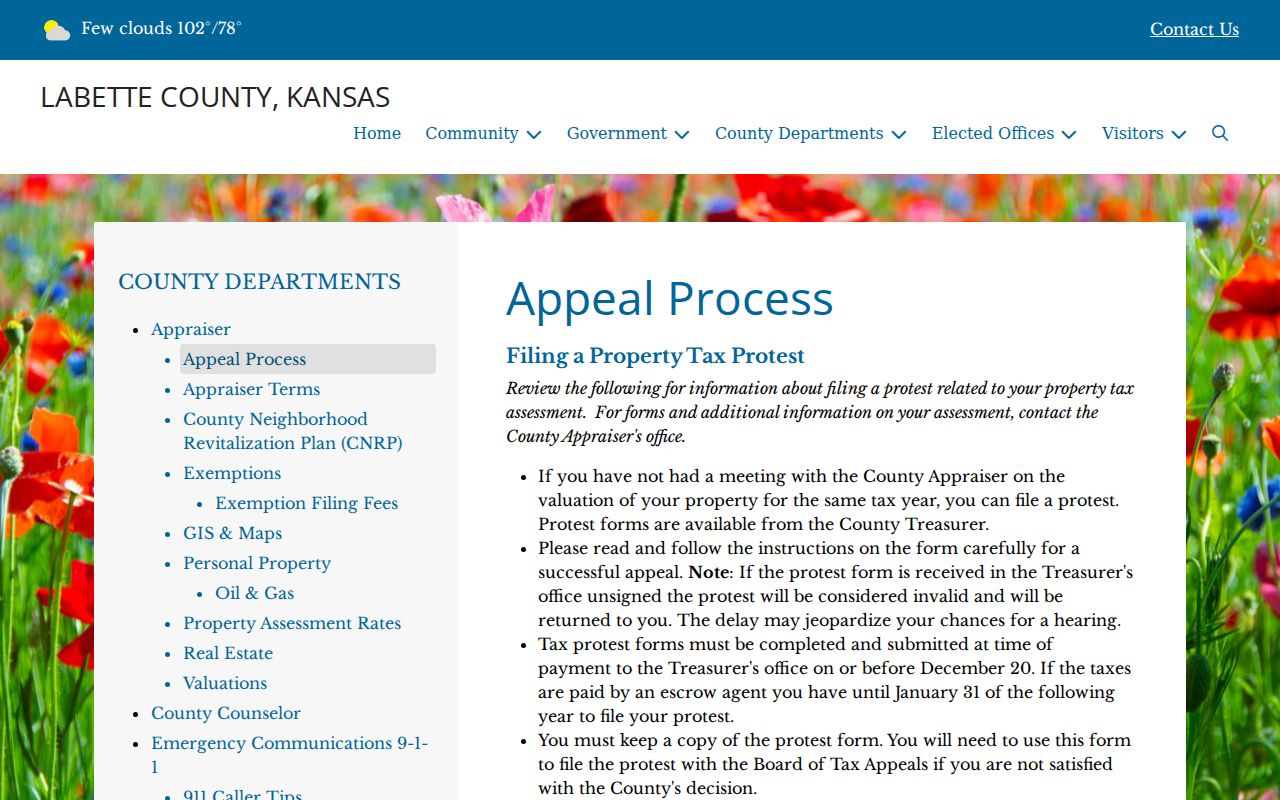
Payment under protest offers another route. County guidance identifies December 20 and January 31 routes depending on how payment is made. The form asks for the county, tax year, property, applicant, and representation details. It is a procedural alternative. It is not extra time for the informal appeal.