
Sources for Labette Former Owners
Labette County history sits across many collections. Pick the record nearest the period you are studying, then use the others to bridge gaps without confusing who lived on land with who held title.
| Source | Known time marker | Access | What it contributes |
|---|---|---|---|
| Recorded deeds | County era after establishment in 1867 | Register of Deeds counter | Transfer parties and legal descriptions |
| Owner atlases | 1906 and 1916 | KSHS and Kansas Memory | Owner snapshot by mapped tract |
| Marriage records | KSHS microfilm, 1867 to 1920 | KSHS catalog and microfilm | Name and family cross-check |
| Local history sources | Coverage varies | Parsons Library, museum, newspapers, cemeteries | Occupants, names, streets, and context |
No published year marks the online deed cutoff.
Reconstruct Labette Ownership Backward
Begin with the newest deed naming the current grantee. That grantor is your next former owner. The legal description, not a mailing address or road name, keeps every step tied to the same tract of Labette County land.
- Find the newest deed for the known current grantee.
- Record the prior grantor, date, reference, and legal description.
- Search that grantor as a grantee in an earlier period.
- Compare the same legal description at each transfer.
- Repeat in physical books when indexed access ends.
- Grantor
- The party who transferred an interest.
- Grantee
- The party who received it.
- Reverse index
- A grantor-side route through transfer names.
- Chain of title
- The linked sequence of recorded instruments for one tract.
- Quitclaim and warranty deeds
- Different conveyance forms whose legal effect must be read from the instrument.
Labette Deed Books at Oswego
The Register of Deeds sits at 501 Merchant in Oswego. Anyone may inspect the deed books there. Staff will not run your search. Bring names and variants, the parcel number, the legal description, a date range, and any book and page or instrument reference. The office publishes no online grantor-grantee index. That makes the counter essential for a complete Labette County chain, and staff can answer questions about access and copies at 620-795-4931 extension 341 or jgilley@labettecounty.com.
Coverage limit. Labette's online cutoff is not published. Confirm older deed-book and image access directly with the Register of Deeds.
Map Labette Prior Owners in 1916
The 1916 Kenyon atlas maps owners across every Labette County township. It bridges a historic surname and today's parcel geography, especially in rural areas. The 1906 Standard Atlas adds another time marker. Neither atlas substitutes for the deed that conveyed title. View the Labette County atlas record on Kansas Memory.
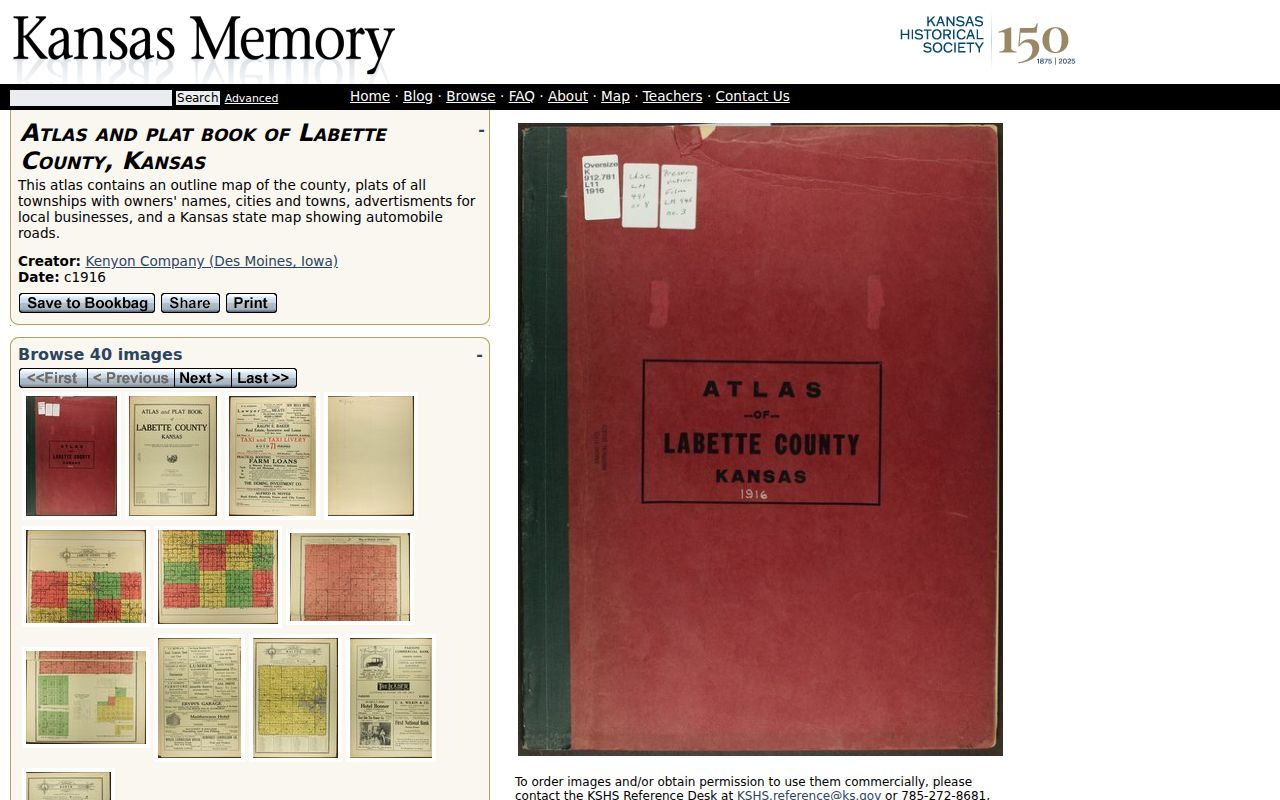
Use the atlas surname and the mapped land position to narrow the courthouse deed books. Then test the legal description against the recorded instruments.
Labette Microfilm and Archive Routes
KSHS ties together county archives, land material, newspapers on microfilm, post offices, cemeteries, townships, and independent cities. FamilySearch catalogs Labette courthouse marriage registers from 1885 to 1896 plus a Kansas county-marriage collection through 1911. Images may require an account or an access point. These fill in names around the deed chain. Open the FamilySearch Labette catalog source.
Marriage, newspaper, or directory evidence can connect name variants, spouses, and heirs. The recorded deed or probate order still proves what happened to the property.
Check Labette Names Beyond Deeds
The Parsons Public Library keeps a Local History and Genealogy Room. A microfilm reader, local newspapers, and history material wait there. The page names no directory years or spans. Call 620-421-5920 with a surname, an address, and a date range. The Parsons Historical Museum holds photographs and MKT Railroad material. Its artifacts date from the late nineteenth and early twentieth centuries. Oakwood Cemetery's land came from the Parsons Town Company. Its first burial came in 1872. Sources like these can identify past occupants or families without ever proving a conveyance.
When Labette Chains Enter Probate
A tidy sale-to-sale chain can snap when a trust, estate, or heir appears. Executors and administrators break chains too. Search the vesting language in the newest instrument. A district-court probate file may explain the authority behind a later deed or name the estate representative. Labette County sits in the Kansas 11th Judicial District. Modern case information may surface through statewide Smart Search, while older files and paper exhibits may require a Parsons or Oswego courthouse terminal or a written request. Sealed and restricted files stay unavailable.
Separate Labette Addresses From Tracts
Old addresses make poor land keys. Postal city names can cross legal boundaries. Rural routes shift, and annexation redrew Parsons coverage. Oswego documents lean on named additions, blocks, lots, partial lots, and even vacated alleys. A legal description is the stronger continuity test. A directory or newspaper search by address shows who occupied a building, not who held title. Only a deed, probate order, or other controlling property record earns the label former owner, because occupancy and title answer different questions.
Limits on Labette Ownership History
County land records begin in the post-1867 era. Earlier claims may call for federal land, territorial, church, or neighboring-county sources. The county has no documented courthouse fire, destroyed-record event, or reindexing date. Never invent one to explain a gap.
The strongest work ties every name to a date, a recording reference, and a matching legal description. An obituary or atlas entry enriches a house history. A cemetery record or photograph does the same without ever proving title.
Keep a working table. Give each transfer one row: recording date, grantor to grantee, deed type, book and page or instrument reference, and the matched legal description. Treat directory or atlas names as leads. That habit keeps a good local story from masquerading as the deed chain.
Lawful use. Trace previous owners for property history, estate work, or due diligence. Never use records to harass, threaten, or target a living person.