
Find Who Owns Labette Property
Answering who owns a Labette County parcel takes four records used in sequence. The Parcel Real Estate Information Search comes first. County material describes two levels of access. Public access shows property information except sales, while registered access adds sales. The public button has been unreliable, so expect no guarantees on its field labels or wildcard rules. If the portal stalls, call the Appraiser at 620-795-2548 or bring the address and legal description to the courthouse.
The parcel roll gives you an owner-of-record lead. The Register of Deeds holds the stronger proof. A newest recorded deed, matched by legal description, beats any name or mailing address resemblance.
The working entry point is the official Labette County parcel portal, shown here at the first stop.
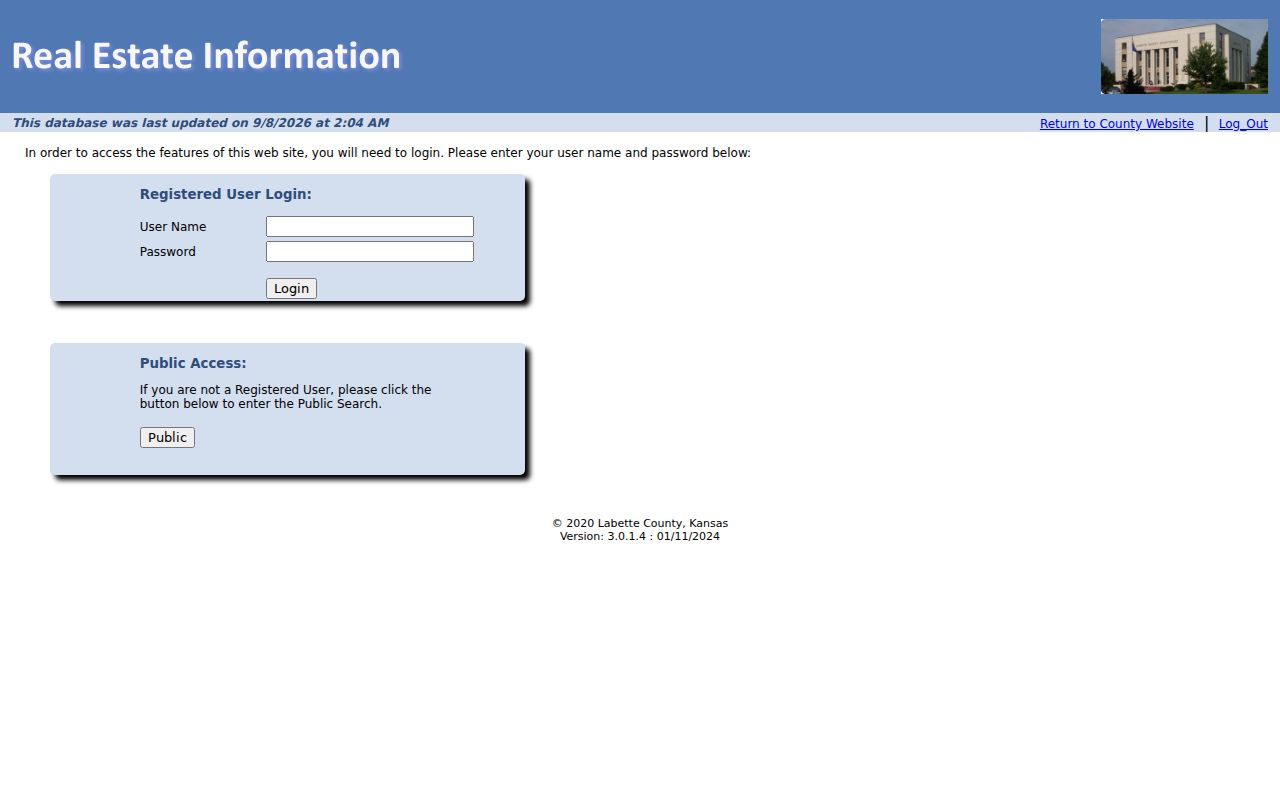
The portal screen displays two separate entry routes, one public and one registered. It does not itself reveal an owner, and it cannot prove the annual roll reflects a newly recorded deed.
- Search the situs address and capture the parcel number, owner spelling, mailing address, and legal description.
- Ask the Register of Deeds for the newest deed tied to that description. The office permits public inspection but does not conduct the search.
- Compare the grantee, recording date, and land description with the roll. Resolve a company name in the Kansas entity search.
- Use public information only for lawful property research. Do not assume the occupant and record owner are the same person.
Read the Labette Owner Clue
The Appraiser advertises a search for a specific property. But the public result card is not dependable. Treat owner name, mailing address, situs address, parcel number, class, legal description, and value as fields to request at the counter. Request them there rather than as labels on a working form. Public access excludes sales. That gap matters when you want both a present owner and a recent transfer. Use one property search to get both.
A situs address identifies the physical parcel. A mailing address is where the tax bill goes. That could be a post-office box, an office, or a different city. Neither address proves the named owner of record lives there.
- Owner of record
- The party named on the government roll for the parcel.
- Grantee
- The party receiving an interest in a recorded deed.
- Legal description
- The lot, block, addition, or section-based text that identifies the tract.
- Situs address
- The street location of the land, distinct from owner mail.
Confirm Labette Ownership by Deed
The Labette County Register of Deeds holds deeds, mortgages, oil and gas leases, plats, and related instruments. These are the county's core deed records. The office publishes no online grantor-grantee index. It lists no coverage cutoff either. Public inspection happens at the courthouse counter. The staff does not search records or give legal advice. So bring the exact owner spelling, the legal description, the parcel key, and a tight date range.
Begin with the newest deed naming the apparent owner as grantee. Compare its legal description to the parcel. A shared surname alone is weak evidence, since relatives, trusts, and businesses often share names. The recorded deed confirms a transfer in the public land record. But it is not a title opinion. It may miss unrecorded interests.
Note: The county publishes no online deed-index cutoff, image price, or verified fraud-alert signup. Confirm access details directly with the recorder.
Resolve a Labette Entity Owner
A personal name is not always what appears. An LLC, corporation, limited partnership, trust, estate, or life estate may show up instead. Copy the granttee's exact spelling from the deed. For a registered business, run the Kansas Business Entity Search by business name. The SOS identification number and the resident agent also work as search terms.
The state database can return entity status, type, mailing address, and formation jurisdiction. It can also return the resident agent, registered office, and public filings. It caps results at 200 and skips sole proprietorships, DBAs, and trade names. An empty result does not make the owner name false. A trust or estate usually needs the deed or the probate file. A representative instrument may also help, rather than a business filing.
Legal Descriptions Settle Close Matches
A city address can change while the tract stays the same. Labette County land records describe town lots by lot, block, and addition. Rural land is described by section, township, and range. The parcel number works as a precise cross-reference. The county has published no format guide for it.
Use the OKRA parcel viewer to locate the tract and compare neighboring parcels. The county treats GIS geometry as tax and reference material, not a survey. When map lines, an address, and deed wording disagree, request the plat or deed records. Consult a survey professional for a boundary question.
Where Labette Owner Records Live
Each official source answers a different slice of who owns this property. Read them together. The tax roll is the efficient first stop for discovery. The recorder holds the transfer document itself. The GIS map ties the parcel to its place on the ground, and the state can explain certain entity names. Keep each record's date in view as you go.
| Source | Owner Info It Gives | Access |
|---|---|---|
| Appraiser parcel roll | Owner lead, mailing and situs details, parcel and value | Public portal or Appraiser counter |
| Register of Deeds | Grantee and legal description on the newest deed | Public courthouse inspection; no located web index |
| Kansas Secretary of State | Registered entity and resident-agent details | Free business entity search |
| County GIS | Parcel location and tax-reference geometry | OKRA viewer and county mapping office |
The owner of record may be an absent owner, a business, a trust, or an estate. Occupancy is not an ownership field. For a purchase, estate matter, easement, or suspected deed problem, have the actual instruments reviewed rather than trusting a single search result.
Recent Labette Transfers Can Lag
Labette County reappraises property each year as it stands on January 1. That annual cycle sets no fixed schedule for updating the owner of record. The county publishes no typical lag. Nothing states the gap between a recorded deed and the name shown on the parcel roll. A deed can be recorded right after a closing. That deed can easily be newer than the assessor's ownership line.
Compare dates. Do not assume one source outranks the other. Ask the Appraiser when its ownership feed was last refreshed. Then ask the Register of Deeds. Request the newest instrument between the apparent grantor and grantee. Registered parcel access includes sales. But that gate does not replace the deed check.
No Search Service at Recorder
Here is a Labette County quirk worth knowing. The recorder does not run searches. Staff makes the land records available. Finding and tracing each document is the visitor's job. Before you visit the second-floor courthouse counter at 501 Merchant in Oswego, come prepared with a name and its variants, the parcel number, the full legal description, and a date range, adding book and page or an instrument reference if another record offers one. That small packet separates the right deed from a same-name filing and prevents wrong conclusions about who owns the tract.
Prepare a Labette Owner Request
A failed web form is beatable. Start with the USPS spelling of the street address. Add the apparent owner name and every initial. Include the parcel number if you have one. Then write out the full lot-and-block or section-based description, plus the years that matter. Ask the Appraiser for the public parcel record, not a custom ownership report. Ask the recorder to open specific deed records for inspection rather than to rule on the title chain.
For an in-person visit, carry your newest reference. Work backward only when ownership history matters. The office is at 501 Merchant, P.O. Box 10, Oswego, KS 67356, with 620-795-4931 extensions 340 and 341. Call first about copying and certification. K.S.A. 28-115 sets recording fees, but a recording charge does not price every inspection or copy.
Precision also blocks false matches. Common names, initials, estate labels, and entity suffixes can produce several plausible records. The legal description and recording date are stronger links than the mailing city. Keep a small log listing each office, the access date, the record reference, and any update date shown on the source.
Limits on Labette Owner Lookups
A public owner result has limits. It cannot prove occupancy or clear title. Nor does it fix exact boundaries or a current sale value. Kansas Safe at Home gives qualifying victims a substitute legal address and mail forwarding, and Kansas law requires Social Security number redaction in public records, subject to listed recorder, court, UCC, and other exceptions. The custodian decides what gets released. KORA opens existing public records, though no agency must answer questions or build a report, and K.S.A. 45-230 restricts certain commercial uses of name-and-address lists. So ask for a defined record, give a narrow date range, and respect any redaction or confidentiality rule.
Lawful use. Labette County owner records support purchase research, estate work, boundary questions, and civic review. Never use owner information to stalk, harass, intimidate, or harm anyone.