
What Labette County Deeds Record
The Register of Deeds preserves deeds, mortgages, oil and gas leases, plats, and related instruments. Each filed document names its parties. It also attaches a land description. Deed records show what was recorded, in other words. They do not prove that every interest was found or read correctly during a Labette County property search, so buyers and title researchers treat them as a starting point rather than the last word on ownership.
| Instrument | Key details | Record purpose |
|---|---|---|
| Deed | Grantor, grantee, date, legal description, reference | Documents a recorded transfer |
| Mortgage | Borrower, lender, tract, release or assignment | Shows a security interest |
| Oil and gas lease | Parties, covered land, reference | May affect mineral interests |
| Plat | Addition, block, lot, approvals | Organizes platted descriptions |
The county publishes no complete online menu of deed types. Ask the counter staff which indexed type fits the document you need.
The Labette Deed Records Counter
The Labette County Register of Deeds sits on the courthouse second floor at 501 Merchant, Oswego, Kansas 67356. Jenifer Gilley is listed at 620-795-4931 extension 341 and jgilley@labettecounty.com. Deputy Judy Roberts is listed at extension 340. Visitors may inspect land records at that counter. The office performs no searches. It accepts no responsibility for missed instruments and gives no legal advice. So arrive prepared. Bring exact names and their variants, a legal description, the parcel number, any recording reference, and a narrow date range. That preparation turns a vague title question into a records inspection the custodian can actually support.
Follow Labette Grantors and Grantees
Every chain begins with a known deed, never a guess about an old occupant. Read the newest instrument naming the current grantee. Copy its grantor, recording date, reference, and full legal description. Then search that same grantor as a grantee in the earlier period. The chain keeps moving backward.
- Identify the newest known grantee and matching tract.
- Read that deed for its grantor and recording reference.
- Search the grantor as an earlier grantee.
- Match the legal description, not merely the street address.
- Repeat until the index or physical book series ends.
- Grantor
- The party transferring an interest.
- Grantee
- The party receiving that interest.
- Chain of title
- The linked sequence of instruments affecting one tract.
- Recording reference
- The book/page or instrument identifier used to retrieve a filing.
Labette's Online Deed Index Gap
Labette County offers no official online grantor-grantee index, no announced imaging cutover, and no stated oldest searchable year. That gap is real. Nobody should claim the county's deed records start online in a certain year, or that scans can be bought through a portal, because the county has published neither.
Counter-first access. Public inspection at the Register of Deeds is the verified route. Confirm image access, copy charges, and historic book coverage with the office.
For remote research, call or email with a precise reference and ask which existing record can be copied. Kansas Open Records Act requests may carry actual costs, estimates, or advance payment.
Match Labette Legal Descriptions
A street address opens the door, but the legal description carries the deed chain. Rural tracts often use section, township, and range. City parcels lean on addition, block, and lot. The county recording checklist asks for the applicable section/township/range or lot/block information. Oswego shows why wording matters. Ordinance material names additions like Cowell's, Victory Homes or Hollingsworth's, Hobart & Tibbets, and Johnson & Folks. It pairs formal lot and block descriptions with common addresses. It may describe partial lots or a vacated alley. That precise language separates a true deed match from a nearby address.
Kansas Fees for Labette Filings
K.S.A. 28-115 supplies the documented fee framework for instruments recorded on or after January 1, 2018. It lists $17 for the first page of deeds, mortgages, and other instruments, $13 for each additional page, $32 per page for town plats, $16 for a mortgage release or assignment, $13 for certifying a record, and $12.50 for an acknowledgment. Other statutory categories may apply.
Confirm the total for the exact document before filing or ordering. A Sales Validation Questionnaire is required for deeds and affidavits of equitable interest unless an exemption applies. The recorder checks the sales price under Kansas guidance.
Older Labette Deeds and Atlases
Labette County dates to 1867. KSHS identifies atlas material from 1906 and 1916. The 1916 atlas offers owner plats for every township, an ownership snapshot from before modern parcel IDs existed. Those plats can point toward a surname and a tract, but they are not conveyances. Open the 1916 Labette atlas source.
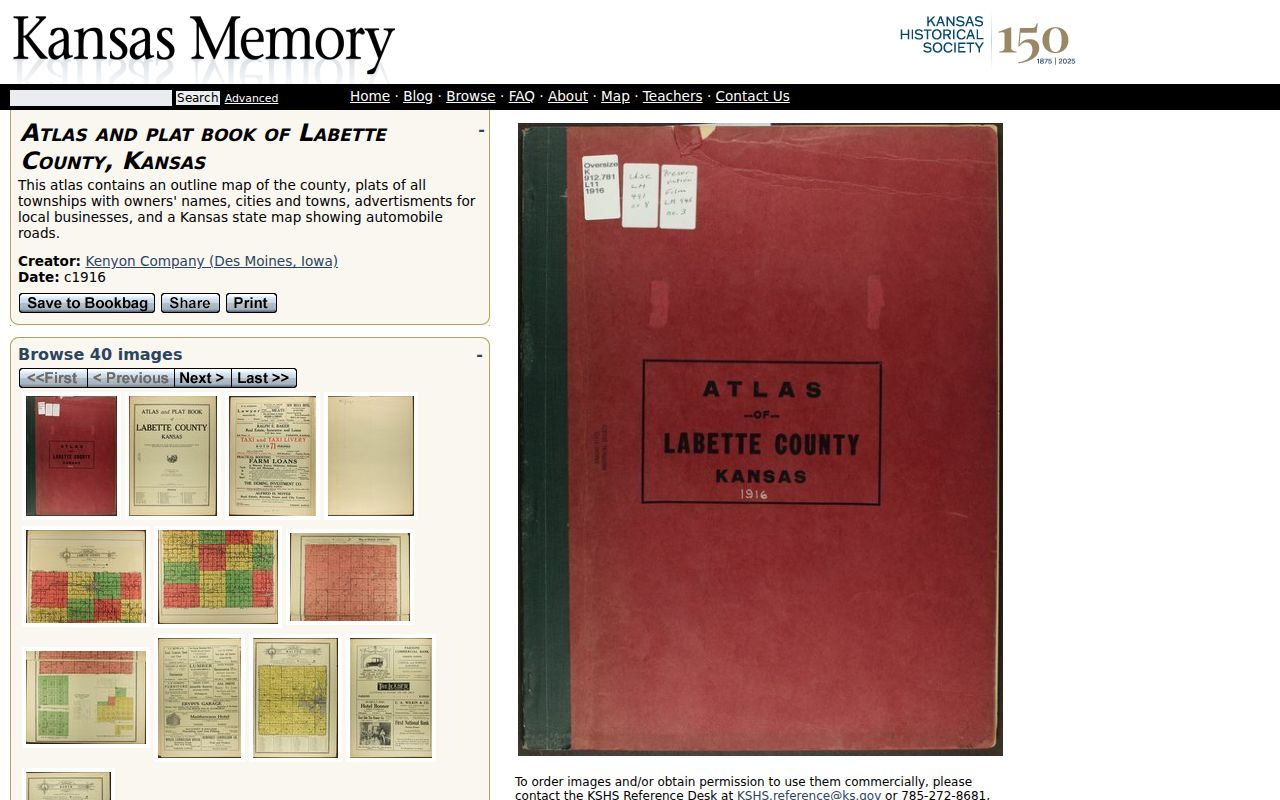
The atlas can seed a courthouse book search by owner and legal geography. KSHS catalogs, FamilySearch, microfilm, local newspapers, cemeteries, and probate files may explain the people between transfers.
Beyond Labette County Deeds
A deed is only one thread in the chain. A careful title review also pulls mortgages, assignments, releases, plats, oil and gas leases, liens, and any court filings. Court files can supply foreclosure, quiet-title, partition, probate, or judgment context around the same parcel. Releases deserve special attention. A recorded mortgage says nothing on its own about whether the debt still stands. The release is what settles the question.
The 11th Judicial District serves Labette County from courthouses in Parsons and Oswego. Newer case information often shows up in Kansas Courts Smart Search. Older files and paper exhibits may take a courthouse terminal or a written request instead. Restricted and sealed material stays off limits.
When the grantee is an LLC or corporation, the Kansas Secretary of State Business Entity Search can confirm the exact legal name. It also shows entity type, status, formation details, resident agent, registered office, and public filings. Search by business name, Kansas SOS ID, or current resident agent. Results cap at 200 entries. The database skips many sole proprietorships, DBAs, trade names, and general partnerships. A missing entity result does not mean the recorded party never existed.
Labette County offers no official property-fraud-alert signup. A 2026 Kansas bill proposed new notarization and deed-fraud safeguards. The official bill record marks it as dead. That bill is not current law, and it does not mean Labette uses biometric authentication. Suspicious deed mail belongs with the Register of Deeds. A pricey copy solicitation belongs there too, at its published number.
Request a Labette County Deed
Give the Register of Deeds the parties, the document type, the recording date, and any instrument number or book and page you know. Include the exact legal description. Ask whether the office issues plain or certified copies, how delivery works, and the current charges. The office publishes no online image-pricing page, so confirm costs directly.
The recording checklist is straightforward but strict. Signatures must be notarized as shown. The first page needs a three-inch square in its upper-right corner for the registry stamp, plus a complete legal description and an original or certified copy. These are filing rules only, not a promise that any instrument is sufficient for every deal.
Keep the office response with your copy. A later searcher should see exactly which names, dates, and land description were supplied, and whether the document is plain or certified.
Recorded, not guaranteed. Deed records show filed instruments. They are not a title opinion, and unrecorded or misindexed interests may require professional review.